The structure of the Chronicle’s gatherings today (‘collation’)
 Julius B XIII bottom edge
The physical features of a manuscript can provide significant information about its history – from medieval creation to modern curation. The study of a manuscript book’s construction is known as ‘codicology’ (literally, ‘the study of the codex’). It generally includes examining the current features of the manuscript (much like a librarian or archivist would do to write a catalogue description) as well as investigating the evidence for any historical developments (from initial creation to growth or rebinding across time as the manuscript moved through different collections). To fully appreciate the scribal activity in the Chronicle of Melrose, it is crucial to examine the codicology and use this information as the backdrop to the scribal profiles and their work.
The study of a manuscript’s structure usually involves determining the organisation of all the physical booklets (the ‘quires’ or ‘gatherings’) which make up the manuscript today. This results in a ‘collation’ of the gatherings: descriptions or diagrams which map their structure. Knowing how a given folio relates to its gathering can illuminate the nature of a scribe’s work: perhaps a missing folio in the middle of a gathering (visible as a ‘stub’) explains a disjuncture in the scribe’s writing; perhaps a ‘stub’ at the end of the gathering suggests no more text was anticipated and the folio was cut away to be repurposed; perhaps a scribe began their work at the start of a fresh gathering because they were working in tandem with others; perhaps a folio with existing text became associated with the manuscript later but as a ‘singleton’, physically and textually independent from the folios around it.
A standard way to express the information about the structure of a manuscript is as a ‘collation formula’. There are different formula styles: below are some formulae for each part of the Chronicle of Melrose based on the style used in N. R. Ker, Catalogue of Manuscripts Containing Anglo-Saxon (Oxford, 1957) (see p. xxii). The large Arabic numeral is the gathering number in the order they appear today; the superscript number is how many folios are in that gathering; where a gathering ‘wants 8’ it is missing the 8th folio in that gathering.
- Julius B XIII, ff. 2–47: 18 28+1 after 7 38+1 after 4 48 56 wants 6, probably blank 68 wants 8
- Faustina B IX, ff. 2–75: 110 210+1 leaf inserted after 2 38 48 +1 inserted after 7 58 wants 8 68 73 1, 2 and 3 are half-sheets 84+2 after 3 98 104
Collation formulae are notoriously difficult to comprehend, being as they are a standardised shorthand for a large amount of codicological information. They also include some assumptions (e.g., if a stub is present, can we always assume a full folio is now ‘missing’ or ‘wanting’, or might it never have been there if a ‘singleton‘ folio had been bound in?).
A more explicit description of the gatherings’ structure is presented in the diagrams and tables below. These reflect the gatherings as they appeared in August 2023. Because the current binding sometimes prevents features from being visible (such as obscuring the presence of stubs), the information below sometimes draws on Broun, The Chronicle of Melrose Abbey, chapter 6. The manuscript was disbound in 2005, meaning Broun was able to see much more clearly the configuration of each gathering.
The manuscript was rebound into its present form in 2006, after Broun’s analysis. There are, as a result, slight differences with Broun’s description. In Julius B XIII Gathering III, the singleton in the middle of the gathering (f. 23) has been bound today the other way, i.e., with the stub between it and f. 24, not between it and f. 22 as before (so, following Broun’s summary at p. 195, this gathering now ‘wants 6’, rather than ‘wants 5’). Also, a bifolio (ff. 41 and 46) has been bound out of sequence in this current binding, for an unknown reason (f. 41 currently appears between ff. 45 and 46).
All folios are made from parchment.
Cotton MS Julius B XIII, ff. 2–47: diagram and description of current structure (as of August 2023)
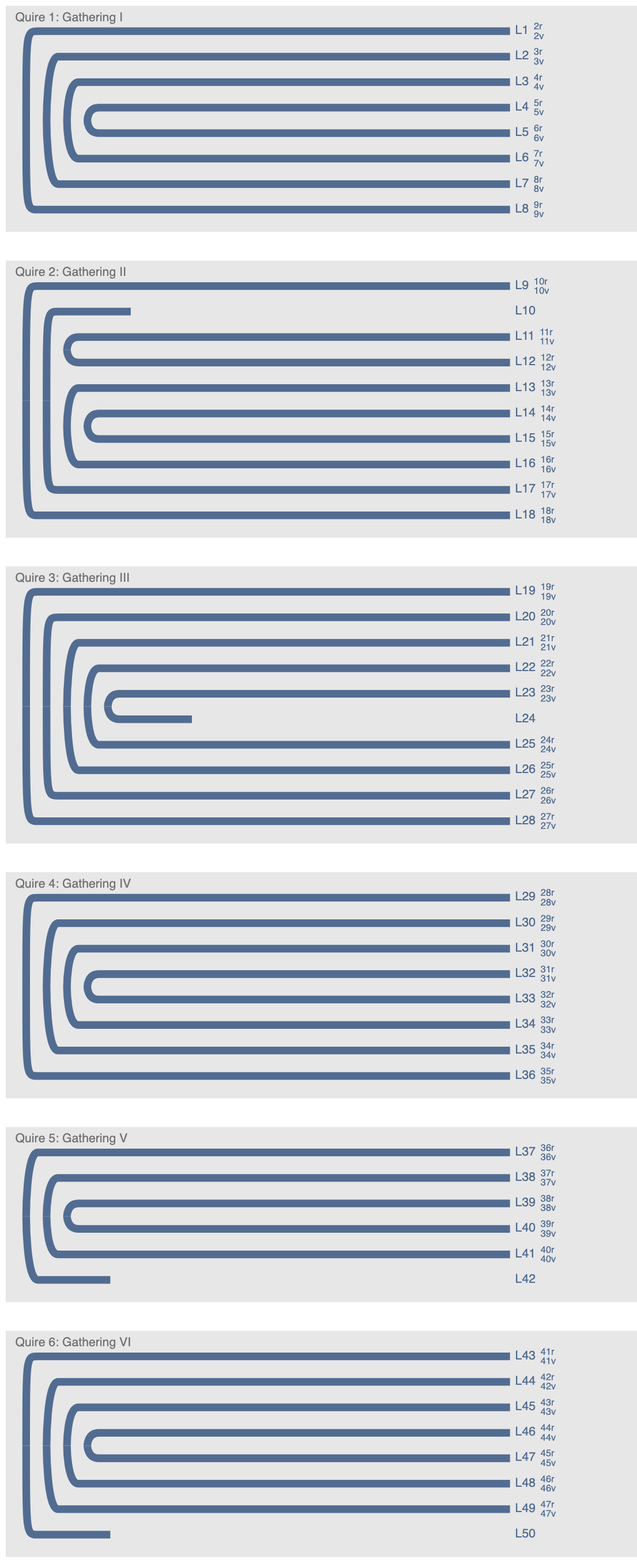 These visualisations were created using VCEditor on 20 February 2024. L stands for 'leaf': these numbers are not used in the edition.
Table: description of Cotton MS Julius B XIII, ff. 2–47
|
Gathering |
Quire signature (Scribal profile 5) |
Ink foliations (Scribal profile 2) |
No. folios currently |
Comment |
|
I |
B |
ff. 2–9 |
8 folios |
A regular 4-bifolio gathering. Sewing is visible between ff. 5 and 6. |
|
II |
C |
ff. 10–18 |
9 folios |
Sewing is visible between ff. 14 and 15. F. 17 is a singleton. It is not clear why: perhaps a scribal error led to a folio being cut out. A stub is visible between ff. 10 and 11. A bifolio (ff. 11 and 12) has been bound incorrectly between ff. 10 and 13 (f. 12 should come after f. 16: see the quire signature, which numbers f. 12 B7). The binding mistake was made before the ink foliation was added in the early modern period. |
|
III |
D |
ff. 19–27 |
9 folios |
Sewing is visible between ff. 23 and 24. F. 23 is a singleton. It is not clear why: perhaps a scribal error led to a folio being cut out. The stub of f. 23 is not entirely visible but is probably pasted to f. 24r. |
|
IV |
E |
ff. 28–35 |
8 folios |
A regular 4-bifolio gathering. Sewing is visible between ff. 31 and 32. |
|
V |
F |
ff. 36–40 |
5 folios |
Sewing is visible between ff. 38 and 39. F. 36 is a singleton. The final folio of the gathering was presumably cut away as unused parchment (it coincides with the end of Hugh of St Victor’s De tribus maximis circumstantis gestorum). |
|
VI |
G |
ff. 41–47 |
7 folios |
Sewing is visible between ff. 44 and 45. F. 41 is a singleton. A stub is visible after f. 47. The text on f. 47v finishes mid-sentence. The final folio was presumably either cut away or f. 41 was always a singleton. |
Cotton MS Faustina B IX, ff. 2–75: diagram and description of current structure (as of August 2023)
 These visualisations were created using VCEditor on 20 February 2024. L stands for 'leaf': these numbers are not used in the edition.
Table: description of Cotton MS Faustina B IX, ff. 2–75
|
Gathering |
Quire signature (Scribal profile 31) |
Pencil foliations (Scribal profile 28) |
No. folios currently |
Comment |
|
I |
B |
ff. 2–11 |
10 folios |
A regular 5-bifolio gathering. |
|
II |
C |
ff. 12–22 |
11 folios |
F. 14 is a singleton, positioned there later. The tapering on the original parchment itself shows it was never a bifolio (perhaps the end of a roll). At some point the leaf was reinforced with more support to allow it to be bound. |
|
III |
D |
ff. 23–30 |
8 folios |
A regular 4-bifolio gathering. |
|
IV |
E |
ff. 31–39 |
9 folios |
F. 38 is a singleton. It was initially the flyleaf (see the reference to it on f. 37v), then it was positioned after f. 54 (see the lower margin foliations), before being moved to follow after f. 37. |
|
V |
F |
ff. 40–46 |
7 folios |
Sewing is visible between ff. 43 and 44. F. 40 is a singleton: it is not clear why. A bifolio (ff. 41 and 46) has been bound incorrectly after f. 45. This binding mistake was made after all foliations had been added in February 1884, and possibly after the manuscript was rebound in 2006 (no mention is made by Broun of f. 41’s incorrect positioning). |
|
VI |
G |
ff. 47–54 |
8 folios |
According to Broun, these were originally mostly singletons: one bifolio (ff. 48–49) has been divided and bound with six other singletons. Today, a gathering has been fashioned by attaching them to each other. F. 54 was positioned in the gathering later. |
|
VII |
H |
ff. 55–57 |
3 folios |
This is apparently three singletons, though it is difficult to see any stubs today. Broun suggests (p. 83) that this is the remains of a 10-folio gathering along with Gathering VIII, split apart by a binder. |
|
VIII |
J |
ff. 58–63 |
6 folios |
FF. 61 and 62 are singletons, with their stubs visible at f. 59r. The sewing of the gathering is visible between ff. 60 and 61 (not ff. 59 and 60 as would be expected). |
|
IX |
K |
ff. 64–71 |
8 folios |
A regular 4-bifolio gathering. |
|
X |
L |
ff. 72–75 |
4 folios |
According to Broun, this is four singletons, possibly the remains of an 8-folio gathering with the final four folios cut away. Today, a gathering has been fashioned by attaching them to each other, though the structure is difficult to make out: probably f. 72’s stub has been pasted to f. 75v; f. 75’s stub to f. 72v; f. 73’s stub to f. 74v; and f. 74’s stub to f. 73v. |
Author: Jo Tucker
Last updated: 30/07/2026