Sources and authorship in the Chronicle of Melrose?
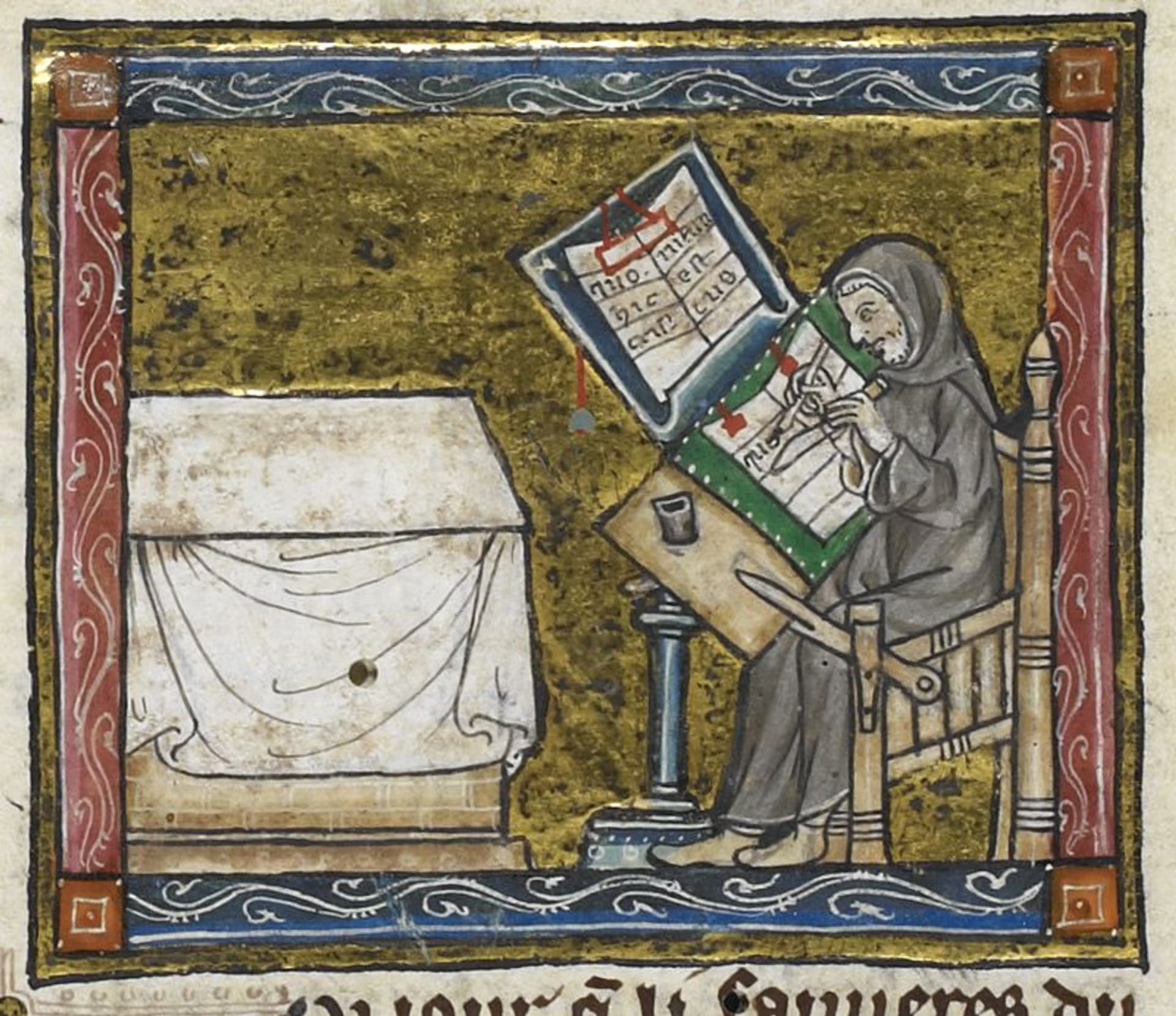 A scribe copying from a manuscript, c. 1315-1325 (BL Royal MS 14 E iii, f. 6v)
Whose words are we reading in the Chronicle? Typically, scribes would not compose a chronicle from scratch. The act of beginning a chronicle usually meant taking a ‘base text’ (or sometimes, multiple base texts) and copying, editing or blending them to suit the purpose. The text might then be updated, drawing in any number of other sources (such as other chronicles, letters, or word-of-mouth reports).
A normal preoccupation for a chronicle scholar today is to try and unearth the exemplar sources that were used to compile a given text. The primary method used is known as ‘textual collation’: comparing your text to others and looking for overlap in phrases which suggest a direct or indirect relationship. Some textual collation has been undertaken for the Chronicle of Melrose, as is reflected in the footnotes in the digital edition (for example, see footnote 4 at Faustina B IX, f. 4r or footnote 1 of the translation at Julius B XIII, f. 41v). It is widely appreciated, however, that there are limitations to this approach. There is so much flexibility and freedom in what scribes might do – how they might adapt, abridge, embellish, miscopy the text in front of them. Moreover, so many manuscripts have been lost that we may never build an accurate picture of the sources of a chronicler, nor identify definitively the authorship of a given passage.
This discussion here will offer a brief introduction to what is known about the sources used by the scribes in the different sections of the Chronicle. A fair amount of work has been done on this question by the Andersons (The Chronicle of Melrose), Archie Duncan (‘Sources and uses in the Chronicle of Melrose’), and Dauvit Broun (The Chronicle of Melrose Abbey, chapter 4, pp. 49–53). Their insights are drawn together here.
In summary: initially, a small team of scribes at Melrose Abbey copied Hugh of St Victor’s Chronicle and annals up to 1171 using a blend of pre-existing sources and possibly omitting a chunk of years between 250 and 730 (for more discussion, see What was the original chronicle?). After they had completed this work, the chronicle became a ‘contemporary’ record, gradually growing at the hands of various Melrose scribes across a few generations, incorporating new annals and other kinds of material which became available to the monks along the way.
Hugh of St Victor’s Chronicle, also known as De tribus maximis circumstantiis gestorum (‘The three best memory-aids for learning history’)
Cotton MS Julius B XIII, ff. 2–40
Scribal profiles 3 and 8
This is not really a ‘chronicle’ as such, more of a handbook for students on memorising historical dates and people. It is found in around forty other manuscripts, and was composed in Paris some time between 1124 and 1137. Some of the extant manuscripts (such as Melrose’s) were extended beyond 1137. Melrose’s manuscript source is not known. For further discussion, see Harrison, ‘Hugh of Saint-Victor’s Chronicle’, where other surviving manuscripts of the Chronicle text are identified.
Annals for the years 1 to 249, finishing mid-sentence at the end of the gathering
Cotton MS Julius B XIII, ff. 41–47
Scribal profile 24
The ‘base’ for these annals is thought to be Bede’s Chronica Maiora, abbreviated and blended with other material (as yet unstudied). The Chronica Maiora extended from Creation to the 720s. In the digital edition, footnotes compare the text in Julius B XIII to the published edition: Bede’s Chronica Maiora (De Tempore Ratione, ch.66), in Bedae Chronica Maiora ad A. DCCXXV, Eiusdem Chronica Minora ad A. DCCIII, in Theodor Mommsen (ed.), Chronica Minora, Seac. IV. V. VI. VII, vol. iii, Monumenta Germaniae Historica, Auctorum Antiquissimorum, vol. xiii (Berlin, 1898), 223–354, at 247–321 (available on Archive.org here).
Introduction and annals for AD 734–956
Cotton MS Faustina B IX, ff. 2r–8r
Scribal profile 24
The introduction here begins with Bede, ‘truthful historian and distinguished teacher—the honour and glory of our people’ (Faustina B IX, f. 2r). The chronicler praises Bede’s efforts in writing a history but laments that no one has since tried to continue his work. They therefore humbly attempt to continue from where Bede left off. The text quotes Bede’s Ecclesiastical History of the English People at AD 731, 733 and 734, and then states: ‘the history which follows has been excerpted here and there from various places’ (Faustina B IX, f. 2v). It then continues the annals from 734 up to 956, finishing mid-sentence.
Broun has discussed how the early scribes of the Chronicle (including this one) took on an ‘authorial’ role that extended to the selection of sources they utilised, and how they blended and supplemented them. His initial textual collation work ‘suggests that the text itself was shaped by them individually’ (Broun, The Chronicle of Melrose Abbey, p. 49). He notes that the work of Scribal profile 24 was ‘[t]he most ambitious and impressive’ effort in this regard, ‘characterised by a blending of a text akin to Historia Regum and Historia post Bedam with Henry of Huntingdon’s Historia Anglorum’ (p. 49). The Andersons also discuss the sources in this section, identifying them as belonging to this ‘Northumbrian group’, for which no source text survives (The Chronicle of Melrose, pp. xi–xii). They suggest this primary source for Melrose ‘probably includes a chronicle that ended before the annal for 1130, and a Northumbrian continuation, which may have ended in 1152’.
In the digital edition, some textual collations have been noted in footnotes, comparing the Chronicle’s text with Diana Greenway’s 1996 edition of Henry of Huntingdon’s Historia Anglorum; Cambridge Corpus Christi College MS 139 (Historia Regum); and British Library MS Royal 13 A VI (Historia post Bedam). For a good example of this in action, see footnote 4 at f. 4r.
In other words, the sources in this section seem to belong to a family of northern English chronicles which includes Historia Regum (attributed to Symeon of Durham) and the Historia post Bedam; it was also informed by Henry of Huntingdon’s Historia Anglorum. The question of ‘authorship’ is more difficult to establish: when the Melrose scribe writes that the following text has been assembled ‘from various places’, were they describing their own effort, or simply copying an exemplar text? Does the description of Bede as ‘the honour and glory of our people’ mean the monks of Melrose self-identified as English at this time? (For this argument, see Dauvit Broun, ‘Becoming Scottish in the thirteenth century: the evidence of the Chronicle of Melrose’, in S. Taylor, B. B. Smith, G. Williams (eds.), West Over Sea: Studies in Scandinavian Sea-Borne Expansion and Settlement Before 1300 (Leiden, 2007), pp. 19–32.)
Annals for AD 956–1016
Cotton MS Faustina B IX, ff. 8v–11v
Scribal profile 37
According to Broun (The Chronicle of Melrose Abbey, p. 51), in this section the predominant source material is that related to the family of northern English chronicles (especially Historia Regum and Historia post Bedam), while Henry of Huntingdon’s Historia Anglorum is no longer a source. However, this scribe introduces ‘items relating to the papal succession from a source that has not hitherto been identified’.
Annals for AD 1017–1171
Cotton MS Faustina B IX, ff. 12r–21r (minus f. 14 which was inserted later)
Scribal profile 8
According to Broun (The Chronicle of Melrose Abbey, p. 52), from the annal for 1017 ‘the chronicle becomes simply a compressed form of a text akin to Historia Regum and Historia post Bedam, and the strain of papal items from another source disappears.’
The Andersons discuss the use of the predominant ‘Northumbrian’ source in this section, the appearance of a ‘Scottish source’ in the twelfth-century annals, and Melrose’s concordance (i.e., similar text) with the Chronicle of Holyrood and Roger of Howden’s chronicle (The Chronicle of Melrose, pp. xi–xv). They also suggest that (p. xiv): ‘[a]fter the end of its Scottish source, the chronicle seems to have been copied from drafts based upon more or less contemporary notes, collected presumably at Melrose.’
There are likely other underlying sources in this section as well. An example is the material relating to the Crusades in this section. This topic featured in Arpad Kuffler’s 2026 PhD on ‘Older Alliance? Anglo-Scottish responses to the Holy Land crusades, c.1095 – c.1272’ where it is shown that the Melrose chroniclers potentially utilised sources such as chronicles of crusading participants.
Annals from 1171–1270, finishing mid-sentence, incorporating various other texts
Cotton MS Julius B XIII, ff. 21r–75v
Various scribal profiles
From here, the text becomes a ‘contemporary record’ (though rarely if ever being updated immediately as events occurred). The sources therefore diversify: letters, word of mouth, contemporary notes, lists. Like many monasteries at the time, the inhabitants might have acquired their sources through various means and connections: some via the regular General Chapter meetings in Citeaux, some through connections to other Cistercian houses, some from visitors to the monastery, perhaps also from other chronicles.
The annals themselves are sometimes elaborate prose accounts which must have taken some time to craft, presumably drawing on multiple sources. See, for example, the lengthy annals for 1214–17 (ff. 30v–36r), or the annals from 1263 which then morph into the ‘little work’ on Simon de Montfort (beginning in 1263 at f. 64r, explicitly finishing at f. 72v), or the account of miracles at Melrose (ff. 61r–62v).
Other entries seem to be more informal and were perhaps added directly into the manuscript without an intermediary source, such as the list of abbots of Melrose (f. 63v), or the list of burials at the abbey (f. 38v), or a note in the margin about who succeeded as porter of St Serf’s (f. 56v). A glimpse into the drafting phase might be offered by those annals for the 1270s and 1280s which were added ad hoc to spaces in the manuscript after the more routine chronicling had ceased: 1271, 1272, 1275, 1277 and ‘1282’.
A campaign of work might glue together a few different kinds of source. An example is that of Scribal profile 104. Its sources include records of ecclesiastical appointments and departures (sometimes with precise dates and information, some from Melrose or from nearby Cistercian houses like Newbattle, others from further afield such as Durham); records of international events relating to the Crusades; and a tranche of records on burials at Melrose Abbey (presumably from community memory or perhaps written records). Most of the entries were relatively prosaic, but the profile’s work is also interspersed with more elaborate accounts, for example of King Alexander II’s death in 1249 on Faustina B IX, f. 55v (notably, Alexander was then buried at Melrose). This scribal profile’s work exemplifies what we imagine a typical update to a chronicle looks like: information was received and kept, or notes were drafted from informants, which then accumulated until they were added in bulk. But evidently this was not an annual affair. For at least a few years or even decades before this, these notes were simply kept alongside the chronicle but not copied. This would be how the chronicle was experienced for periods in the mid-thirteenth century: as some filled gatherings, plus a collection of notes. There could be a long incubation period where these notes accumulated before anyone added them. We can speculate on why chronicling starts and stops, though often we are guessing (see the discussion of The abbots of Melrose: influence on the chronicle?).
Some scribes were adding material within a year or so after the event, but most others were working at more distance, sometimes a decade or two. These can be investigated by looking at the list of scribal profiles and comparing the contribution with the profile’s dating. For example, Scribal profile 114 was responsible for continuing the ‘little work’ on Simon de Montfort under AD 1268, and then adding annals for AD 1269 and 1270, but the profile is datable ‘after 14 April 1286’. The difference in time can lead to more or less digested accounts, with more extended and reflective prose being more likely after time had passed.
Twice the Chronicle itself was used as a source for later additions. On an inserted folio (f. 54), there are two summaries of relations between kings of Scotland and England. The items were selectively copied from the chronicle itself: from AD 945 to 1209 (f. 54r); and from AD 1162 to 1193 (f. 54v). On another occasion, a list of burials at Melrose was drafted, using the annals themselves for the information (f. 38v).
The digital edition allows for many more contributions and their sources to be investigated. Here, four kinds of source will be highlighted in more detail: letters, charters, the verse chronicle, and the ‘little work’ of Simon de Montfort.
There are several examples in the Chronicle of Melrose where letters are referred to, quoted, or copied in full. This is not untypical in chronicles of this period and type. Some letters were incorporated into an annal as part of a narrative; others were inserted without any context. Presumably the documents themselves or their copies were kept with the chronicle manuscript, or with other records, until the moment they were copied. Letters give an insight into the information networks available to the monks of Melrose.
- f. 33v: In the annal for 1216, there is a copy of a letter from the abbot of Glenluce on the transformation of the moon. ‘When he came to Melrose, as we stood near and pestered him, he told the story of this very event to us with his own lips, and all who were there listened and marvelled. He then wrote it down into the following letter.’
- f. 38r: An inserted folio containing the first part of a letter describing the capture of Damietta in 1219.
- ff. 45v–46r: Letter describing the capture of legates and prelates by imperial forces on their way to the papal council under AD 1241. The scribe here gives us a motive for why letters might be copied: ‘And since it is tiresome to relate everything, I have thought it appropriate to insert here a letter which the lord [abbot] of Cîteaux sent to the abbot of Savigny from the imperial prison’.
- ff. 47r–49r: Copies of letters relating to the sacking of Jerusalem under AD 1244.
- ff. 50r–52r: Copies of letters of Emperor Frederick II and Pope Innocent IV on imperial-papal relations under AD 1245.
Another similar source of immediate availability at the abbey was benefactions recorded in charters. As a royal foundation Melrose was not short of donations in the 12th and 13th centuries. A collection of originals survive (many of these can be viewed and read at https://modelsofauthority.ac.uk), along with a mid- or late-13th-century cartulary (NLS Adv. MS 34.4.11). All of the explicit mentions of charters in the Chronicle occur in the work of one scribal profile, the first continuator, Scribal profile 60. This is datable after 17 March 1199, which is removed by some significant time from the donations themselves. Though all of the original documents survive, none have the same scribal profile as the chronicle, though they were potentially written by Melrose scribes. Perhaps it is striking that any donations at all were recorded in the chronicle; or perhaps it is odd that there are not more references to donations, given how many there could be and the fact that probably some of the scribes were engaged in both chronicle and charter writing. Indeed, the structure of these entries mirror charter diplomatic to an extent. Either way, the archive did not continue to supply information to the chronicle. Only for a moment does it seem to have been regarded as chronicle-worthy, and only for a small handful of documents.
- Annal for 1185: ‘Robert Avenel, a novice, our benefactor, died on 8 March. He gave his land of Eskdale to God and St Mary and the monks of Melrose, as his charter testifies; may his blessed soul live in glory always.’ = probably NRS GD55/39
- Annal for 1188: ‘Richard de Moreville, constable of King William, and his wife Avicia and William their heir gave to God and St Mary and the monks of Melrose as perpetual alms the land which is called Park as their charter testifies; may their happy alms always be in eternal memory.’ = NRS GD55/108
- Annal for 1193: ‘Jocelin bishop of Glasgow, before many witnesses, gave the church of St Kentigern the bishop, Hassendean, to God and St Mary and the monks of Melrose, as perpetual alms, for the salvation of his soul and of his ancestors and successors, as his charter testifies. May his blessed soul always be in eternal glory and happy memory.’ = NRS GD55/121
- Annal for 1193: ‘Donnchad son of Gilla Brigte of Galloway, before Bishop Jocelin and many other witnesses, gave to God and St Mary and the monks of Melrose a certain part of his land in Carrick which is called Maybole as perpetual alms for the salvation of his soul and of all his progenitors, as his charter testifies.’ = NRS GD55/29 and /30
Another distinct text is what the Andersons call the ‘Verse Chronicle’ (The Chronicle of Melrose, pp. xxiv–xxvi): ‘a metrical history of the kings’ reigns, in elagaic couplets, down to the year 1214’. These verses were squeezed into the relevant annals. Their place or time of composition cannot be established with certainty, though the Andersons suggest it was perhaps added to the Chronicle by 1264:
843: Cináed son of Ailpín f. 5r
859: Domnall f. 5v
863: Custantín f. 5v
878: Áed whitefoot f. 6v
879: Grig son of Domnall f. 6v
897: Domnall f. 7r
908: Custantín son of Áed f. 7r
943: Máel Coluim f. 8r
952: Illuilb f. 8r
961: Dub f. 8v
965: Cuilén f. 8v
969: Cináed f. 8v
994: Custantín f. 10r
995: Grim or Cináed son of Dub f. 10r
1003: Máel Coluim f. 10v
1034: Donnchad f. 12v
1039: Mac Bethad f. 12v
1055: Lulach f. 13v
1056: Máel Coluim f. 13v
1093: Domnall f. 16r
1097: Eadger f. 16v
1107: Alexander f. 17r
1124: David f. 17v
1153: Máel Coluim f. 19r
1214: William (the only one inserted next to his year of death rather than accession in 1165) f. 30v
On the ‘little work’ of Simon de Montfort, the Andersons (The Chronicle of Melrose, p. xix–xx) note that the stated sources of information include the canons of Alnwick, Thomas, abbot of Rievaulx, men of various religious orders, and certain trustworthy men. The Andersons conclude that the work must have been composed at Melrose.
Author: Jo Tucker
Last updated: 18/09/2026