Melrose Abbey: a brief introduction
 Melrose Abbey (image source)
The Cistercians
(For a very useful introduction to the Cistercians, see this website. Below is a summary derived from it.)
The religious order to which Melrose belonged began in Burgundy in 1098, when Abbot Robert of Molesme led a small group of monks into the woods south of Dijon in search of a stricter and more disciplined monastic life, built on a literal reading of the Rule of St Benedict. There, they founded a community at what is now Cîteaux, subsequently inspiring the name of a new order, the ‘Cistercians’.
Known as the ‘White Monks’ for their undyed woollen habits, the Cistercians aspired to simplicity in their clothes, diet, buildings and liturgy. Settling in remote, uncultivated places, they aimed for self-sufficiency through their own labour rather than income or rents, relying on outlying farms and granges worked by ’lay brothers’ and becoming especially known for the production and trade of wool. Their churches, all dedicated to the Virgin Mary, were deliberately unadorned – a stark contrast to the richly decorated Benedictine churches of the period.
The growth of the Order was extraordinarily rapid. Initially only male communities were permitted, but from the thirteenth century nunneries were brought into the order. By the mid-twelfth century some 300 Cistercian abbeys stretched across Europe and the Middle East, rising to more than 1,500 houses across Europe by the mid-seventeenth century.
The Order was held together by a strong system of governance. Each community’s mother-house was to visit it annually, and a General Chapter of abbots met every September at Cîteaux to oversee discipline. From 1157, Scottish abbots were permitted to attend the General Chapter every four years – a journey that could amount to at least three months on the road. The Chronicle provides plenty of examples of Melrose abbots travelling to and from these meetings.
Eventually, there were eleven Cistercian houses in what is now Scotland: Balmerino, Coupar Angus, Culross, Deer, Dundrennan, Glenluce, Kinloss, Melrose, Newbattle, Saddell and Sweetheart. There were also at least eight nunneries, among them Berwick, Coldstream, Eccles, Elcho, Haddington, Manuel, North Berwick and Abbey St Bathans. (On the nunneries, see R. Andrew McDonald, ’The foundation and patronage of nunneries by native elites in twelfth- and early thirteenth-century Scotland’, in Women in Scotland: c.1100–c.1750, ed. Elizabeth Ewan and Maureen M. Meikle (East Linton, 1999).)
Melrose Abbey

The Chronicle tells us that: ‘In the 1136th year the abbey of St Mary’s of Melrose was established on the Monday of Easter’, i.e., 23 March (Faustina B IX, f. 18r) and that ‘In the 1146th year the church of St Mary’s of Melrose was dedicated, on Sunday 28 July’ (Faustina B IX, f. 18v).
Melrose was a daughter house of Rievaulx Abbey in Yorkshire. Though not stated in the Chronicle, the founder was David I, king of Scots – his first, but not his only, Cistercian foundation. His establishment of a community at Melrose is thought to have been driven by a combination of piety, power, politics, and personal connections to Cistercians in England.
The name and initial location of the community was based on an early medieval site (‘old Melrose’), associated with St Cuthbert. The monks later migrated 4km west along the River Tweed to the current site. Though closely tied to the Scottish royal family, at the time of its foundation the monastery was not yet considered to be in ‘Scotland’ but rather within an older, greater Northumbrian region. (For more on this, see Broun, The Chronicle of Melrose Abbey, pp. 2–3 and 10–12.)
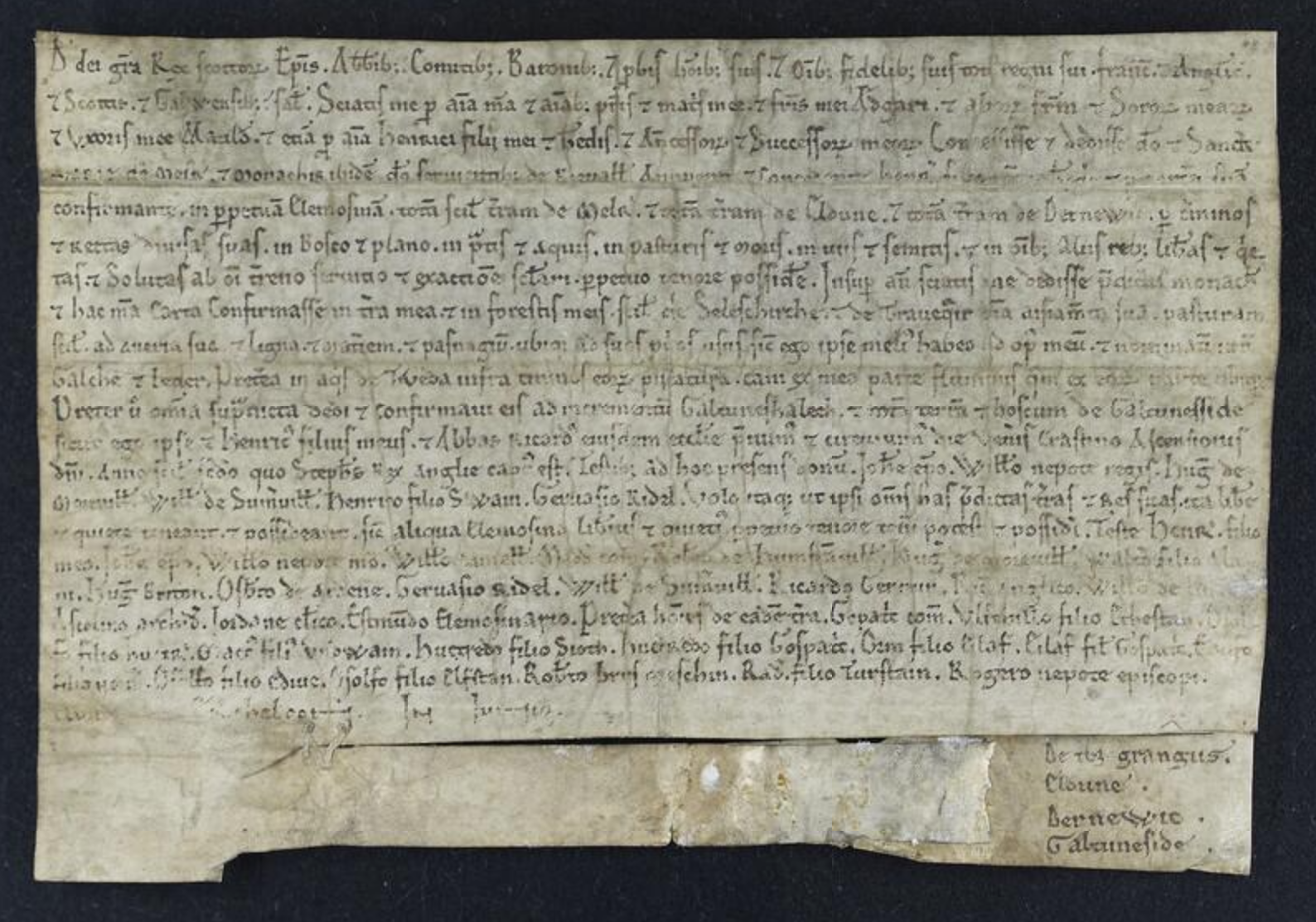 Melrose‘s foundation charter (NRS GD55/1)
See Models of Authority for the image, text and translation
During the period when the Chronicle was active, Melrose received a great number of donations by a range of benefactors, from local landholders to the royal family. These can be explored via the People of Medieval Scotland database: https://poms.ac.uk/record/person/75/.
Melrose later became mother-house to several monasteries, as can be seen in the map below. As such, it was certainly one of Scotland and northern England’s pre-eminent Cistercian houses in the Central Middle Ages.
Most of the current building is datable to the fifteenth century. Records of archaeological excavations at the site can be found on trove.scot.
From 1541, Melrose was placed in the hands of a series of commendators. The abbey was finally secularised (i.e., made into a temporal lordship) in 1609. (For more on this, see Ian B. Cowan and David E. Easson, Medieval Religious Houses Scotland, with an Appendix on the Houses in the Isle of Man (London, 1976), p. 76.)
 Map illustrating the spread of the Cistercians into Scotland
Cistercian communities: size, roles and duties
In order to found a Cistercian monastery there needed to be at least twelve monks plus an abbot. Once established, communities could grow much larger than this. In the mid-twelfth century, Melrose’s mother-house, Rievaulx, was said to be home to 140 monks and perhaps 240 lay brothers (Walter Daniel, Life of Aelred, pp. 37–8). It is difficult to ascertain a precise number for Melrose. By the sixteenth century, the convent seems to have numbered around seventeen monks (Cowan and Easson, Medieval Religious Houses, p. 75).
Cistercian communities were headed by an abbot and served by a large number of other officials, known as ‘obedientiaries’. A rotation system meant the monks were assigned different duties each week, helping in the kitchen, guesthouse, refectory or elsewhere in the church. Lay brothers formed a separate group within the community, undertaking the majority of the abbey’s agricultural and industrial work – as shepherds, cowherds, blacksmiths, cobblers, masons, weavers, skinners, tanners or bakers, for example. They had their own living quarters, clothing and daily schedule of work and prayer.
To help picture the community of people who might have interacted with the Chronicle, here is a list of the main roles in a Cistercian abbey like Melrose. A description of these roles and duties can be found here.
- Abbot
- Prior and sub-prior
- Porter and sub-porter
- Novice-master
- Guestmaster (hosteller)
- Sacrist
- Cantor (precentor) and succentor (sub-cantor)
- Cellarer and sub-cellarer
- Refectorer
- Infirmarer
- Novice
- Monk
- Lay brother
The Chronicle gives us some insights into these individuals and the expectations of their role. We are told, for example, of the glowing deeds of Abbot Matthew (1246–61): ‘For it is through this Matthew, a good, devout, and most generous man, that the house of Melrose has several possessions and many allowances for the monks as a result of his facility for acquisition; because of him we have pittance-breads on Fridays in Lent when we are fasting on bread and water; he also built our large houses at Berwick; and moreover, he constructed both many shelters for cows and oxen as well as a great chamber for the abbot, which is on the bank of the river, together with the addition of not a few other buildings.’ (Faustina B IX, f. 62v) We are also told of a fatal incident involving a lay brother: ‘On 17 October, by the carelessness of a badly fixed candle, one of the better granges of Coupar, full of grain, was burnt, and in it the granger, a lay brother.’ (Faustina B IX, f. 32r)
Some monks of Melrose are also given noteworthy accounts: Reginald of Roxburgh went to Norway to negotiate on behalf of the king of Scots, and is described as ‘a monk of Melrose, a man of famed eloquence and the very best judgement’ (Faustina B IX, f. 65v) who ‘truly earned for his own house the eternal gratitude and favour of all future kings in Scotland’ (Faustina B IX, f. 66r). Adam of York, another monk of Melrose, has a vision of the Virgin Mary in the abbey church, and later after his death cures the blindness of William of Duns, a former sacrist of Melrose (as described in Faustina B IX, ff. 61r–62r). This is followed by an account of another Adam (of Lennox), a monk who never slept in his bed and was so renowned for his holiness that ‘the noblemen of the land’ would come to him to offer benefactions and have their confessions heard (Faustina B IX, f. 62r–v).
Which members had access to the Chronicle of Melrose?
There is no direct evidence of who had access to the Chronicle of Melrose – either drafting its text, writing into it, or reading it. (The only attributed scribal profile in the Chronicle is Scribal profile 16 who was likely the sixteenth-century antiquarian John Leland.)
Reading was certainly part of the monastic day, and monks were encouraged to meditate on prescribed texts. An abbey’s library could easily have held hundreds of books in the period in which the Chronicle of Melrose was active, mostly theological works (see further discussion of this here). A Cistercian abbey like Melrose also had a growing archive of letters and sealed documents which they carefully produced and kept (see images of Melrose‘s earliest charters via Models of Authority).
Given the number of hands seemingly involved in the Chronicle, we might imagine that a significant proportion of the community had access to it (though not the lay brothers, who were not literate). This might have included some or all of the obedientiaries described above, as well as the broader community of monks and novices.
An episode in the Chronicle which might be instructive is a recounting of the transformation of the moon, entered under the annal for 1216 (at Faustina B IX, f. 33v). William, abbot of Glenluce, is said to have come to Melrose and ‘told the story of this very event to us with his own lips’, afterwards writing it in a letter. The letter’s text is then given, where it is addressed ‘To the reverend men in Christ, Dom A., prior of Melrose, and the convent at that place’. This passage suggests that the prior himself may have been the author of this section of the chronicle, since he was the recipient of the letter which forms the basis of the account.
Author: Jo Tucker
Last updated: 29/08/2026